

Vaginal Estradiol for GSM — Clinician Prescribing Guide
A 4-page clinical workflow for local vaginal estradiol in GSM, including after breast cancer

Thank you to everyone who downloaded and shared the patient guide last week. The response has been enthusiastic, and it confirms what I’ve believed for years: women are ready for this information.
That guide gives women language and evidence to ask for care that actually works. But that conversation only succeeds if the clinician on the other side of the desk is ready for it.
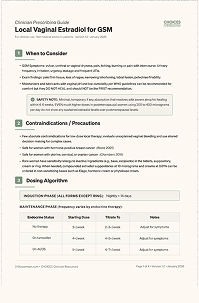
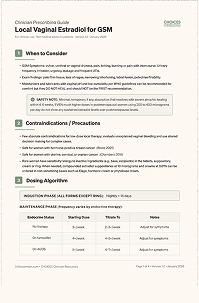
So today I’m releasing the clinician companion: a 4-page prescribing guide (with a printer-friendly version included) for low-dose local vaginal estradiol for genitourinary syndrome of menopause (GSM), including for women with a history of hormone-positive breast cancer.
Download: Local Vaginal Estradiol for GSM — Clinician Prescribing Guide (PDF)
Why this guide exists
GSM is common, clinically visible, and treatable—but the gap between evidence and day-to-day practice is still costing women their quality of life. Too often:
local therapy is conflated with systemic hormone therapy
clinicians defer across specialties (Gyn ↔ Onc ↔ PCP)
pharmacists flag prescriptions, causing delays and unnecessary callbacks
This guide is designed to reduce friction. It’s not a review article. It’s a clinical workflow: when to consider local estradiol, how to dose it, how to write the prescription so it clears the pharmacy, and what to say to a patient who’s been told she can never use estrogen again.
What’s inside
When to consider local therapy: symptom triggers + exam findings (and why lubricants/moisturizers often aren’t enough)
Safety + contraindications: what’s absolute vs what’s individualized (including in breast cancer survivorship)
A dosing algorithm: induction → maintenance, with titration by symptoms (and practical adjustments for ovarian suppression / aromatase inhibitors)
Product selection table: Estring, 10 mcg tablets, 10 mcg suppositories, 0.01% cream—plus dose equivalents, preference fit, and cost notes
Copy-paste prescription language: dispense quantities and instructions that reduce pharmacy bounce-backs
Pharmacy-proofing notes: what to write so dispensing isn’t delayed by misunderstandings
Clinical pearl: when to combine a small amount of cream with ring/tablet/suppository for persistent vulvar/vestibular symptoms
Four misconceptions + corrections you’ll hear in real practice
One misconception deserves special attention: “vaginal estrogen must be limited to twice weekly.” For some patients that’s enough. But for patients on active endocrine deprivation, the default often fails. The guide provides a practical framework to titrate based on response rather than an arbitrary cap.
The guide also highlights a safety point that prevents real-world errors: Estring and Femring are not interchangeable. One is local low-dose estradiol; the other delivers systemic estrogen at a much higher dose. The table is designed to make that distinction impossible to miss.
A note on access
This clinician guide is part of an 8-part series (four for patients, four for clinicians).
The first two guides, this patient guide and its clinician companion, are free so they can circulate widely. The remaining six will be available to subscribers to support continued development of patient- and clinician-ready resources.
If you’d like access to the full series as it’s released, you can subscribe below:
Share it
Download the PDF. Print it. Keep it in your clinic. Share it with the colleague who still lumps local and systemic estrogen together. Forward it to the pharmacist who flagged your last prescription. Send it to your NP/PA/fellows.
Patients are arriving with better information than they’ve ever had. Clinicians should be ready to meet them there.
Download: Local Vaginal Estradiol for GSM — Clinician Prescribing Guide (PDF)
This guide is for clinician education and reference only. It does not establish a physician–patient relationship, replace individualized clinical judgment, or constitute medical advice to patients. The views expressed are Dr. Bosserman’s own and do not represent City of Hope.